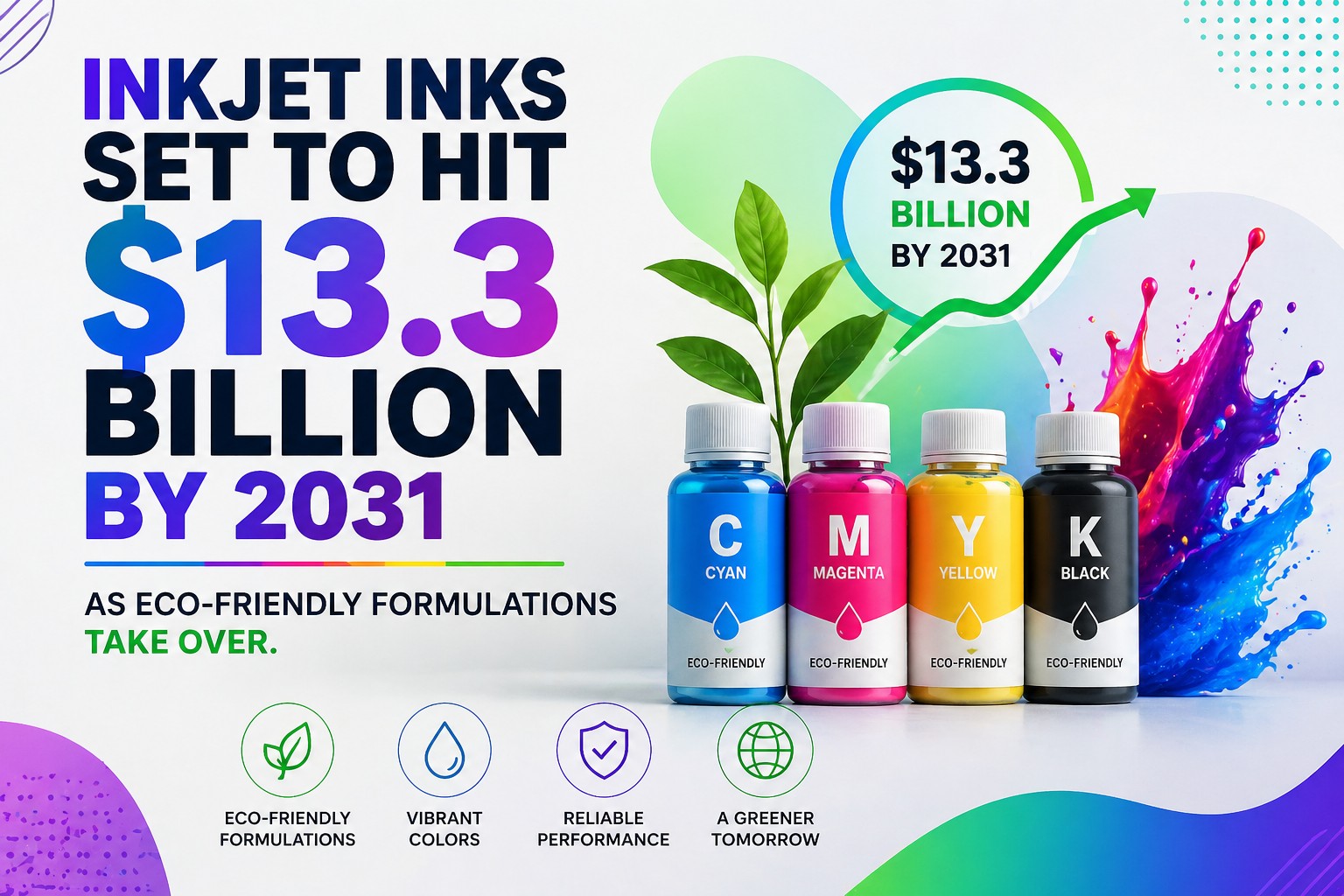
The global inkjet ink market is on track to grow from $9.9 billion to $13.3 billion by 2031, according to Smithers, but the real story lies in how inks are evolving under increasing regulatory and environmental pressure. Manufacturers are rapidly shifting toward water-based (aqueous) inks, which are gaining traction across textiles, commercial printing, books, and corrugated packaging—and now making strong inroads into food packaging due to their safer chemical composition, recyclability, and compliance with strict food-contact regulations. At the same time, radiation-cured inks remain vital in labels and visual communications, with a growing transition from conventional UV to energy-efficient LED UV technologies that reduce heat and power consumption. However, ongoing concerns over chemical migration and indirect food contact continue to limit UV ink adoption in packaging, highlighting a major industry shift where sustainability, safety, and compliance are now driving innovation as much as performance.
To provide the best experiences, we use technologies like cookies to store and/or access device information. Consenting to these technologies will allow us to process data such as browsing behavior or unique IDs on this site. Not consenting or withdrawing consent, may adversely affect certain features and functions.
Functional
Always active
The technical storage or access is strictly necessary for the legitimate purpose of enabling the use of a specific service explicitly requested by the subscriber or user, or for the sole purpose of carrying out the transmission of a communication over an electronic communications network.
Preferences
The technical storage or access is necessary for the legitimate purpose of storing preferences that are not requested by the subscriber or user.
Statistics
The technical storage or access that is used exclusively for statistical purposes.The technical storage or access that is used exclusively for anonymous statistical purposes. Without a subpoena, voluntary compliance on the part of your Internet Service Provider, or additional records from a third party, information stored or retrieved for this purpose alone cannot usually be used to identify you.
Marketing
The technical storage or access is required to create user profiles to send advertising, or to track the user on a website or across several websites for similar marketing purposes.






