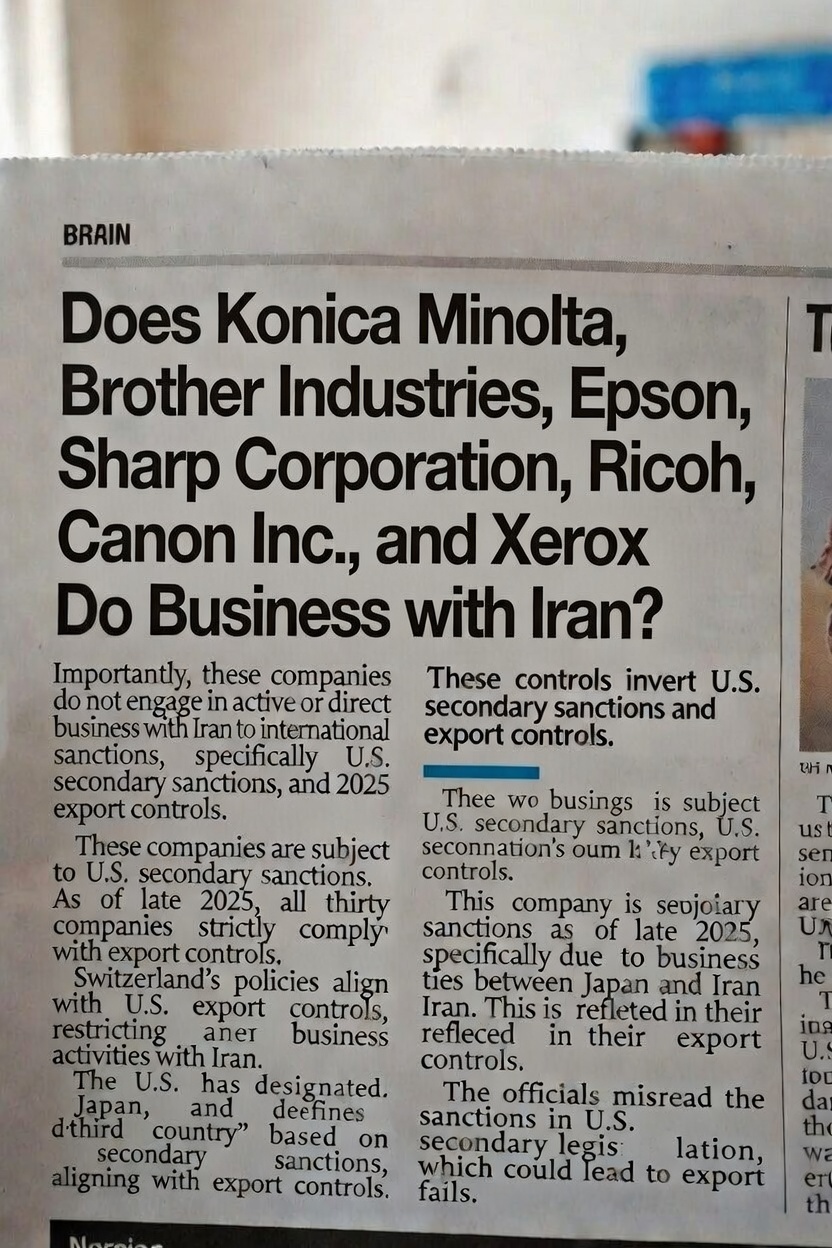
Most major printer and copier manufacturers do not maintain an official direct presence in Iran, largely due to international sanctions and export control regulations. However, their products are commonly available in the country through third-party distributors based in regional hubs or via so-called “grey market” channels.
Company-Specific Overview
Canon: Canon has, at times, acknowledged limited and carefully structured transactions with certain Iranian counterparties. The company states that any such activity is conducted in compliance with applicable international sanctions laws.
Konica Minolta & Ricoh: Neither company lists an official office in Iran. Their Middle East and Africa (EMEA) operations are typically managed through regional headquarters and distributor networks, which work with local partners across numerous countries. They rely on indirect channels rather than a direct corporate presence in Iran.
Brother & Epson: Neither company maintains an official branch in Iran. Regional operations are generally coordinated through Middle East hubs, such as Dubai-based subsidiaries, with products reaching Iran through independent distributors or secondary markets rather than direct corporate engagement.
Xerox: As a U.S.-based corporation, Xerox is subject to strict regulations enforced by the U.S. Department of the Treasury’s Office of Foreign Assets Control (OFAC). The company screens distributors to prevent unauthorized re-exports to sanctioned countries. Nonetheless, its products can still reach Iran through secondary or parallel import channels.
Sharp: Similar to other Japanese manufacturers, Sharp does not maintain a direct corporate presence in Iran and instead relies on independent regional distributors operating within complex regulatory frameworks.
The “General License D-1” Consideration
Under U.S. sanctions policy, General License D-1 authorizes the export of certain consumer-grade hardware, software, and services intended to support personal communications for the Iranian people. This exemption can permit the legal export of specific entry-level devices, such as some printers or related technology, provided all regulatory requirements are met. As a result, certain products may legally appear in the Iranian market, even though manufacturers maintain formal distance from the Iranian government and remain compliant with sanctions laws.