



















Homepage › Forums › Toner News Main Forums › Here’s What AI Really Thinks About Viral Xerox Scandal Videos.
- This topic is empty.
-
AuthorPosts
-

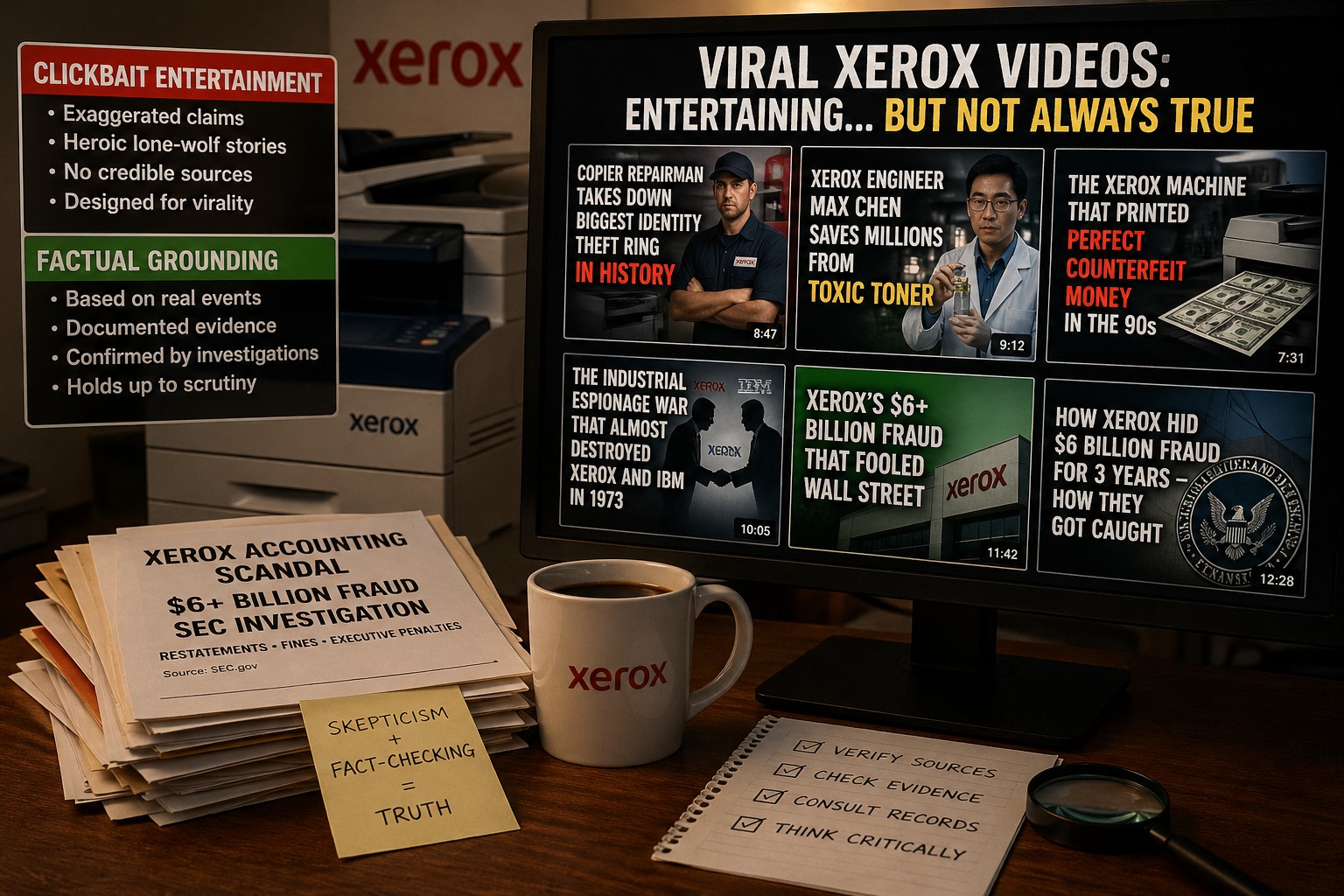
tonerKeymasterThe recent wave of sensational Xerox videos promoted
are a classic mix of clickbait entertainment and occasional factual grounding.
The dramatic shorts—claiming a lone copier repairman dismantled the “biggest identity theft ring in history,” a heroic engineer named Max Chen saved millions from “toxic toner,” or a single Xerox machine printing “perfect” counterfeit money that nearly broke the economy—are heavily exaggerated or outright fabricated for virality. These stories take real kernels of concern, such as the privacy risks from unencrypted hard drives in older digital copiers or the historical use of high-quality color copiers in counterfeiting schemes, and inflate them into heroic lone-wolf narratives that lack credible evidence or named sources.
In contrast, the videos detailing Xerox’s actual $6+ billion accounting fraud in the late 1990s–early 2000s are far more legitimate, aligning closely with well-documented SEC investigations that exposed improper revenue recognition practices leading to massive restatements and executive penalties. Overall, while these videos can spark curiosity about Xerox’s corporate history and the printing industry’s quirks, they prioritize emotional hooks and simplified drama over accuracy, reminding us that in the age of algorithmic content, skepticism and fact-checking remain essential tools for separating signal from noise.
VIDEO: Xerox Copier Repairman Brings Down the Biggest Identity Theft Ring in History.
https://tonernews.com/forums/topic/video-xerox-copier-repairman-brings-down-the-biggest-identity-theft-ring-in-history/
VIDEO: How a Xerox Engineer Saved Millions From Identity Theft from Copier Hard Drives.
https://tonernews.com/forums/topic/video-how-a-xerox-engineer-saved-millions-from-identity-theft-from-copier-hard-drives/
VIDEO: The Xerox Machine That Printed Perfect Counterfeit Money in the 90s.
https://tonernews.com/forums/topic/video-the-xerox-machine-that-printed-perfect-counterfeit-money-in-the-90s/
VIDEO: The Industrial Espionage War That Almost Destroyed Xerox and IBM in 1973.
https://tonernews.com/forums/topic/video-the-industrial-espionage-war-that-almost-destroyed-xerox-and-ibm-in-1973/
VIDEO: How Xerox Engineer Max Chen Saved Millions of People from Toxic Toner.
https://tonernews.com/forums/topic/video-how-xerox-engineer-max-chen-saved-millions-of-people-from-toxic-toner/
VIDEO: CEO Who Exposed Billion Dollar Fraud at Xerox
https://www.youtube.com/watch?v=Antoz3Hl2QE
VIDEO: Xerox’s $6.4 Billion Fraud That Fooled Wall Street
https://www.youtube.com/watch?v=b9vUk6iyVFM
VIDEO: Xerox Hid $6 Billion Fraud For 3 Years – How They Got Caught
https://www.youtube.com/watch?v=otBtaorh9Go
VIDEO: How Xerox CEOs Stole $4 Billion With Fake Accounting
https://www.youtube.com/watch?v=otBtaorh9Go

-
AuthorApril 25, 2026 at 11:19 AM

- You must be logged in to reply to this topic.